#58 - These Are The Steps You As An Artist Should Take If You Want To Take On An Assignment For A Commission
This is how you prevent yourself from wasting time on a customer.Warm-Up Drawing Exercises
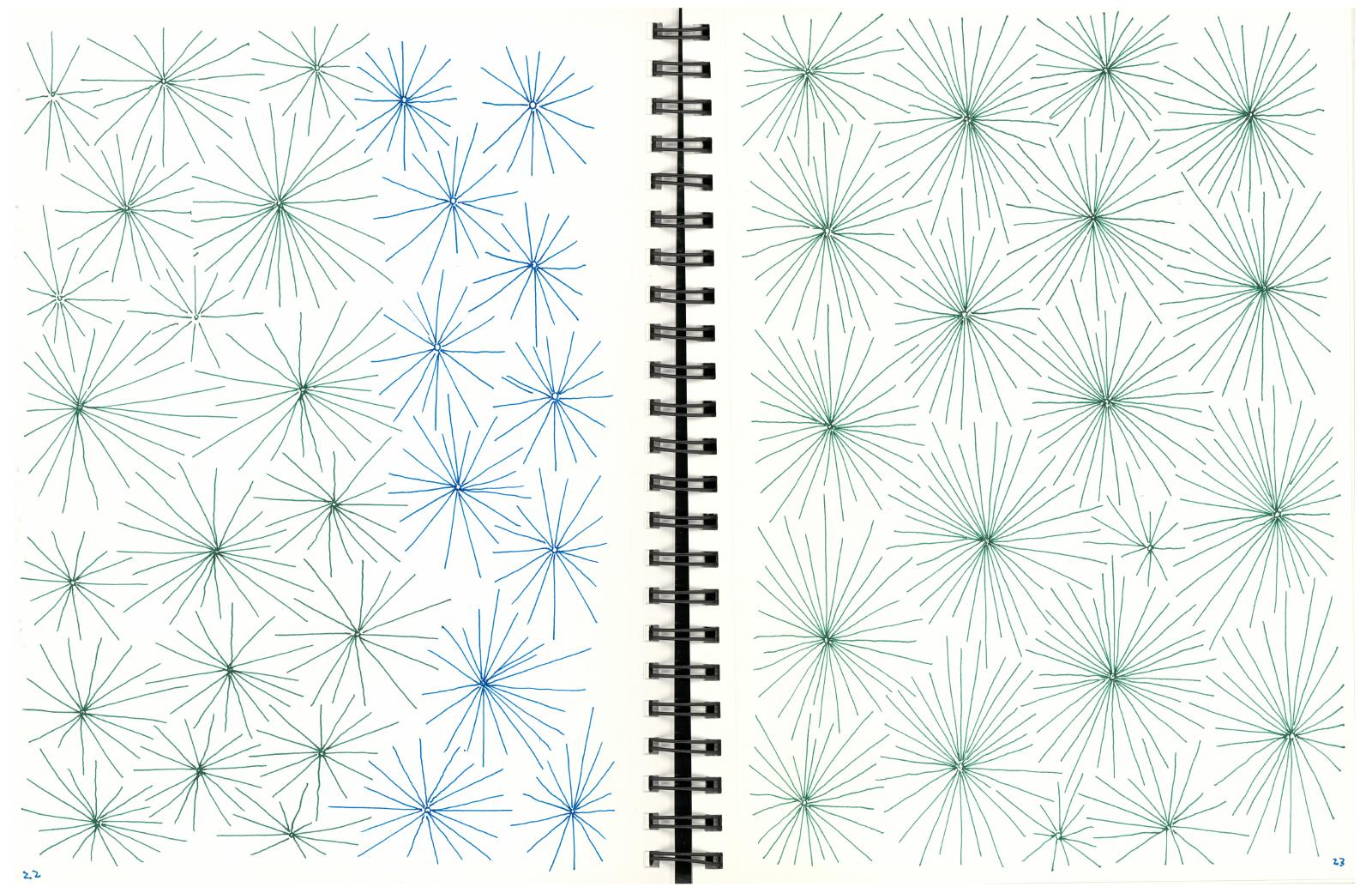
Pages with my line-to-point warm-up exercise. I like to do similar exercises on one page as it tends to make the sketchbook look nicer.
A while back, I made book illustrations for a few self-published writers. It was great fun, and I learned a lot. I wrote about it here.
The trick was to read their book first, so I understood the tone of the story, and to ask questions after that. Which famous movie celebrity did their characters look like the most? What did they think things looked like?
In this article, I will dive deeper into the steps you need to take to make an illustration assignment for a client you take on a success.
I will be making drawings I am happy with, of course, but the goal is also to make drawings a customer is satisfied with. You need to find out what they see in their mind’s eye. If what you produce doesn’t come anywhere near that, they will be disappointed and won’t use the art, which will be a gigantic waste of everyone’s time.
Next, you make “mood boards.” These are collages of images you found that you think are in the right style for the illustration. And you add photo references for the characters.
I can’t show you examples because they tend to be collages of copyrighted material, and you can only use them for private use. You can show this mood board to the customer to get their feedback.
Moodboards can be made and changed very quickly, and it is surprising how good moodboards are at conveying a concept.
You might need a second iteration after feedback from the client. I never had to make a third iteration.
Next come quick, rough preparatory sketches of the various options for the final illustrations. These can also be made in very little time and are easily changed or tossed for better options.
When you and the customer agree on the final design, you can set to rendering the final image. This stage can take a lot of work, which is why you do the moodboards and the preparatory sketches. You don’t want the customer to come back to you after working on a drawing for 160 hours and say they had second thoughts and want a different image now. You need to get them to agree to a preliminary sketch. You want to iron out the problems early on. The moodboards and preparatory sketches are for that.
This is why art contests never work. They give you some prompt, and you are supposed to spend days designing and creating something, second-guessing what a jury wants. You are setting yourself up for failure. Why waste so much of your time when the person making the final decision doesn’t even want to give you a half hour of their time?
Never create a finished piece for someone before you make absolutely sure you understand what they are looking for. This also means never participating in contests.
It is also one of the reasons why we won’t see A.I. replacing artists any time soon. The art being made by A.I. at the moment is stunning! But it is based on a short one-sentence prompt. It can probably replace cheap, free, barely suitable to the task stock photos, but they can not replace photographers who work for Vogue.
If you are a builder and a hotel wants to hire you to build a swimming pool, it is a good idea to interrogate the hotel owner. What does he dream the swimming pool will do for the hotel? If the hotel owner says they would love to see children running around the pool, you know you will need to use rubber tiles and that a pool bar that serves alcoholic beverages is perhaps not such a hot idea.
You need to find out what the customer dreams of and what success looks like in their fantasy.
I read a story somewhere online where they said that during a job interview, one question would be, “design a house.” If the potential employee went to the whiteboard to draw one, they had failed the test. They needed to ask questions before. The interviewer would sigh and say, “it’s a house for giraffes.”
A while back, the design industry had a problem: customers were expecting agencies to pitch ideas to them for free. They would then vet the options and choose I’ll-know-it-when-I-see-it style. As I explained above, that setup is a recipe for failure.
And the agencies knew this.
They didn’t know anything about the company, its company culture, what the CEO was like, what the products were, what the competition was like, what the customers were like, or the specific problem the customer was struggling with.
“Now pitch a solution. We’ll tell you if it is the right solution.”
You can imagine the agencies did not want to waste time and money creating pitches for nothing. They were almost sure to fail.
What did the design industry do, clever cookies that they are? They came up with an additional service called “Design Strategy.”
It works like this: you hire the agency to do a “design strategy” project for you. They will organize workshops with you where many people from your company are invited, lunch is arranged, creative brainstorm sessions are held, to get all the information they need from the customer.
And then, they write a report where they analyze the problem and propose possible solutions.
Such a design strategy project will cost you north of one hundred thousand dollars.
And THEN they can design a pitch for you.
Brilliant, right? You need to interrogate your customer before you can design a solution for them. The design industry makes its customers pay one hundred thousand dollars for just the interrogation stage! Before they even start considering making a pitch!
Clever. Weeds out all the freeloaders who want something from you for free.
When I was hiring software engineers, I always had a short, simple test. It was to write a very simple function. From it, I could already learn a lot: were they experienced (e.g. making no mistakes), write clean maintainable code, efficient code, robust code, et cetera. It gave me an insight into whether they were as experienced as they said they were, and whether I wanted them to touch our code or not. All from writing a simple function.
But there was another hidden test in there: I purposefully gave them too little information.
If they enthusiastically lunged into the problem without asking questions first I knew they were junior. They’d rush off in the wrong directions on projects. I would still hire them! It just meant I knew I had to micro-manage them until they understood what we were doing.
If they asked questions first, I knew they were more senior. There was so much I hadn’t specified! Which programming language? Are they allowed to use standard libraries? Does the code have to be maintainable, efficient, robust?
Ask questions first before you start making things for someone else.
So that’s a “short” explainer on how to take on assignments: ask questions first. Interrogate the customer. Make sure you understand the assignment before you try to think up solutions.
This holds for making art on assignments, also. Hi friend!
As some of you may have seen, I am posting on Instagram again. I am making 15-second Reels where you can see me doing one of my favorite drawing exercises.
I hope it will also make you want to try that drawing exercise. These are fun—for me at least, and when done in moderation—and they help me improve considerably. I am posting them as Shorts on YouTube also.
These are time-lapse drawings. Those always look cool, don’t they? But they are not as useful for other artists. What you want is to see how other artists make marks. As I write about here. I initially went for real-time drawing videos, but I have to figure out a way to let them not be boring. I may have found a solution, so watch this space.
I am experimenting with approaches. I tried this last week : a video where you see both the time-lapse and the real-time video at the same time. I was hoping that, that way, it would be both useful and not boring. But, this video did legendarily bad. (No one can predict what will work beforehand. All you can do is try things out.)
As of this writing (on Friday, and this article goes out on Sunday, I just posted this attempt. Here I collage real-time mark-making, heavily edited. I got this idea when watching another video like it.
I used to post my best things on social media, but eventually, I realized the stupidity of doing that. You don’t control it; the platform can shut you down anytime. In ten years, social media platforms will have changed so much as to be unrecognizable.
A while back, my account started bleeding 10-50 followers a day, and I thought, why should I bother? Now I post things on social media, and the purpose of these videos is to get people onto my newsletter as that is where I post my best stuff, with an archive on my website.
Then recently, all sorts of photographer YouTubers suddenly started making videos about how they thought Instagram was dead. No matter what they tried, their accounts had begun to bleed followers, 10-50 a day, as mine had.
I think there are meetings at Instagram’s head offices where they decide which accounts they want to allow to grow. When my follower count started to decline, I think they wanted to focus more on growing other accounts that were still small, and larger accounts were beginning to have a tougher time.
I went to look at my account, and lo and behold! It had been growing by 10-50 followers a day for a month! The only thing I can think of is they had this meeting at head offices again and were worrying about TikTok attracting all the young people. How to get the young people back?
By pointing them to the accounts that young people like, of course!
Sixty percent of my followers on Instagram are younger than twenty-four, and I am guessing the photographer accounts’ demographics are different. They may attract older audiences with enough disposable income to buy expensive cameras.
This, you must understand, is me second-guessing what Instagram wants to see from us. Because we can’t ask Instagram what they want. All we can do is try things, take stabs in the dark and get it wrong most of the time.
Which is what the article above was about. Ask questions before you make something. The only thing is, we can’t ask these social media platform questions, and we can’t find out what they want to see on their platform. Amazingly.
Instagram, if you are reading this, tell creators what you want to promote, and I am sure many people will start making relevant posts!
YouTube does a better job of this. They have a “Creator Academy” that is good. They have humans analyzing trends and sharing intelligence in their blog, and it’s really good.
The cool thing about the newsletter is that it reaches every subscriber. I may count myself lucky if ten percent of my followers on Instagram see my posts. Every subscriber gets my newsletter, and I currently have a fifty percent open rate!
I do have to work for the fifty percent open rate. For starters, I have to make these letters the best they can be. I throw away a lot of stuff I write. I know that if I receive a newsletter that isn’t that good, I hesitate to open it next week.
It is also important to keep your list of email addresses clean. I silently remove people from the mailing list if they haven’t opened any of my letters in three months. That’s fine! My newsletter is not for them anymore. That’s okay.
The open rate is important because many are subscribed through Gmail, which is Google, and if I send out a newsletter, Google can see how many people open the email. If very few do, it might start marking my newsletter as spam.
But I have started filming myself drawing! And as I write about here it is very useful! I get to stare at myself drawing like staring at your favorite artists making art , seeing where my arm didn’t do what I wanted it to, and figuring out how to practice doing it better.
It is beneficial to try to do things that serve multiple purposes.
My hands filmed drawing:
1) gives me a fun project to draw for,
2) provides an opportunity to practice,
3) allows me to demonstrate my favorite drawing exercises,
4) results in videos I can study to improve myself,
5) results in videos and images I can share online.
In this letter, I am referring to articles I will be sharing through this newsletter in a while, which you can already read if you follow the links because this is what I am doing this week. It means you are getting four articles for one this week!
Reels and Shorts work for me at the moment, but what works on social media and what doesn’t changes so quickly that I have to write about that now, or not at all.
Also, I thought it was an ironic footnote to this week’s article where I discuss why you should only do work for some entity after you get a chance to ask questions first to have a fighting chance of making the right stuff. However, we don’t get to ask Instagram and YouTube questions, do we? This means we’re forced to take stabs in the dark as to what these platforms want us to make. And what the platforms want to see you doing even changes fast, so what works now probably won’t work in a while.
I said, don’t make things before asking questions. And yet, I am making stuff for YouTube and Instagram without knowing what they want to see.
I hope you have a creative week!
Ayal